If you have ever debated whether to buy a washer and dryer or stick with trips to the laundromat, you are not alone. The question of laundromat cost vs home washing machine expenses is one that every budget-conscious household faces at some point. The answer is not as straightforward as you might think. It depends on your living situation, family size, how often you do laundry, and how you value your time.
We put together a real-world cost breakdown so you can see exactly where your money goes with each option. No sales pitch, just honest numbers.
Upfront Costs: The Price of Getting Started
The biggest difference between the two options hits you right at the start. Buying a home washer and dryer requires a significant upfront investment, while using a laundromat requires virtually nothing.
- Home washer and dryer set: A reliable mid-range pair costs between $1,200 and $2,500. Budget models start around $800 for the set, but tend to need repairs sooner. High-efficiency models can run $3,000 or more.
- Installation and hookups: If your home or apartment does not already have hookups, plumbing and electrical work can add $500 to $2,000 to the total.
- Delivery fees: Most retailers charge $50 to $150 for delivery and haul-away of old units.
- Laundromat startup cost: $0. You just show up with your clothes, detergent, and quarters (or cash for the change machine).
For a typical household, the all-in cost of buying and installing a washer-dryer set lands somewhere around $1,500 to $3,000. That is a significant chunk of money that could go toward rent, groceries, or savings.
Monthly Utility Costs: Water and Electricity
Home machines add to your water and electricity bills every single month. Here is what the numbers look like for a family doing about 8 loads per week:
- Water usage: A standard top-load washer uses about 30 to 40 gallons per load. High-efficiency front-loaders use roughly 13 to 15 gallons. At Los Angeles water rates (roughly $0.015 per gallon), that adds $15 to $25 per month.
- Electricity for the washer: About $5 to $8 per month for a standard machine.
- Electricity or gas for the dryer: This is the big one. Electric dryers can add $25 to $50 per month to your bill. Gas dryers are cheaper to run at $15 to $25 per month, but require a gas hookup.
- Total home utility cost: Roughly $45 to $80 per month in added water and energy bills.
At the laundromat, utility costs are baked into the price of each machine cycle. You do not see a separate water or electric bill. A typical wash cycle costs $2.50 to $5.00 depending on machine size, and drying runs $1.50 to $3.00. For 8 loads a week, that works out to about $130 to $180 per month at most laundromats.
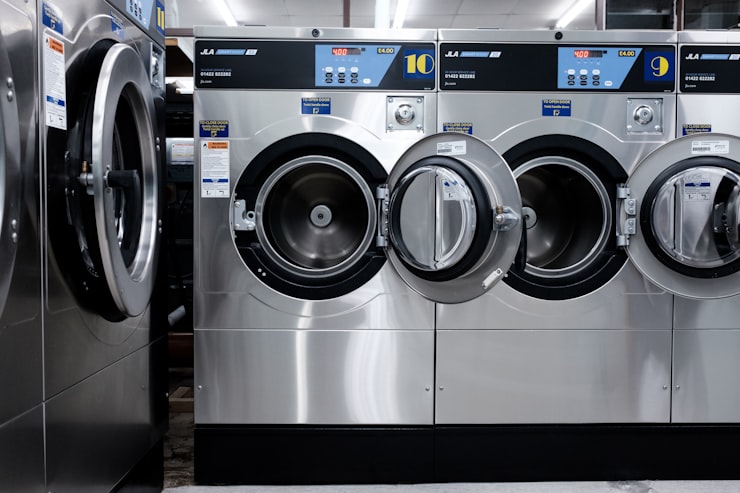
Worth noting: At a laundromat with large-capacity machines, you can combine multiple home-sized loads into a single large load. A family that does 8 small loads at home might only need 4 to 5 loads at a self-service laundromat with bigger machines. That brings the real monthly cost closer to $80 to $120.
Maintenance, Repairs, and Replacement
Home appliances break down. That is a fact of life. Here is what to expect over the lifespan of a washer-dryer set:
- Average lifespan: 10 to 13 years for a washer, 10 to 15 years for a dryer.
- Repair costs: The average washing machine repair costs $150 to $400. Dryer repairs run $100 to $350. Most households face at least 2 to 3 repairs over the machine's lifetime.
- Replacement cost: When machines die, you are back to spending $1,200 to $2,500 all over again.
- Annualized maintenance and depreciation: Roughly $20 to $35 per month when you spread purchase price, repairs, and eventual replacement over the machine's lifespan.
At the laundromat, maintenance is not your problem. When a machine breaks, the owner fixes it or you use the one next to it. You never pay a repair bill, and you never deal with a flooded laundry room.
The Time Factor: What Is Your Time Worth?
This is where the comparison gets interesting. At home, a single load takes about 60 to 90 minutes from wash to dry. Since most households only have one washer and one dryer, you are running loads back to back. Eight loads could stretch across an entire day.
At the laundromat, you can run multiple machines at once. Those same 8 loads of laundry can be washed and dried in about 90 minutes to 2 hours total. That is a massive time savings, especially on a busy weekend.
If you value your free time at even $15 per hour, the time savings of doing all your laundry at once at the laundromat adds up to real money. For families juggling work, kids, and everything else, getting laundry done in one focused trip can be a game-changer. Check out our laundromat etiquette guide to make your visits as smooth and efficient as possible.
Convenience and Lifestyle Considerations
Cost is not the only factor. Your living situation plays a huge role in which option makes more sense:
- Renters: If you rent, buying a washer and dryer may not even be an option. Many apartments in Los Angeles do not have hookups, and landlords often do not allow installations. The laundromat is the practical, affordable choice.
- Small spaces: Even if hookups exist, a washer-dryer set takes up valuable square footage in a small apartment. That space might be better used for storage or living area.
- Large items: Home washers typically handle up to a queen-size comforter at most. For king-size comforters, heavy blankets, or sleeping bags, a laundromat's large-capacity commercial machines are the only realistic option. We have a complete guide to washing comforters at the laundromat if you need tips on handling bulky items.
- Homeowners with families: If you own your home, have space, and do a high volume of laundry (think families with young kids), the per-load economics of owning eventually pull ahead after a few years.
The Monthly Cost Comparison: Side by Side
Here is a realistic monthly breakdown for a family of four doing roughly 8 loads per week:
Home Washing (Monthly)
- Appliance depreciation and repairs: $25
- Water: $20
- Electricity/gas (washer + dryer): $40
- Detergent and supplies: $15
- Total: approximately $100 per month
Laundromat (Monthly)
- Wash cycles (5 large loads/week): $60
- Dry cycles: $40
- Detergent and supplies: $10
- Gas or transportation: $10
- Total: approximately $120 per month
The home washing option appears to cost about $20 less per month in ongoing expenses. However, that does not include the $1,500 to $3,000 upfront investment. If you factor in the initial purchase, it takes roughly 6 to 12 years for home washing to break even compared to the laundromat, depending on machine quality and how often repairs come up.
So Which Option Wins?
There is no universal answer. The laundromat cost vs home washing machine debate really comes down to your situation:
The laundromat makes more sense if you:
- Rent your home or apartment
- Do not have washer-dryer hookups
- Want to avoid a large upfront purchase
- Value getting all your laundry done quickly in one trip
- Need access to large-capacity machines for bulky items
- Move frequently and do not want to transport heavy appliances
Home washing makes more sense if you:
- Own your home and plan to stay for 8+ years
- Already have hookups and space
- Do very high-volume laundry (large family, cloth diapers)
- Strongly prefer doing laundry at any hour without leaving home
For many Los Angeles residents, especially renters and small households, the laundromat is the smarter financial choice. You skip the upfront cost, avoid repair headaches, and get your laundry done faster with commercial-grade machines.
Visit Sunshine Coin Laundry
If a laundromat fits your budget and lifestyle, we would love to see you at Sunshine Coin Laundry. We offer clean, well-maintained machines in a range of sizes, a comfortable facility, and friendly attendants who are always happy to help. Our location on Vermont Ave in South Los Angeles is open 7 days a week from 6 AM to 10 PM, with free parking right out front.
Stop by, try a load, and see for yourself why our neighbors keep coming back every week.